2020-09-22

Lebanon & The Culture of Mediocrity

Lebanon & The Culture of Mediocrity

Think about the last time you were genuinely satisfied, happy, or even amazed by something in Lebanon. Now, take a moment and think about what made you feel this way. Chances are, in 9 out of 10 cases, you had such low expectations, that the simple fact of things being done properly left you with unprecedented sentiments of elation. You even probably rushed to tell your friends about it using expressions such as “For a moment I forgot I was in Lebanon”, or “they were so professional, I thought it was a foreign company”, or even “The finishing was amazing, like imported brands”.

Why do we do this? Because Lebanon has fully embraced a culture of mediocrity*. 

I understand that, at this point, some might already feel the need to crack their knuckles to type that scathing comeback, while revving their fake patriotism engines on indignation fuel, but how about we embark on a joint mea culpa and examine how we are all contributing in making our culture a mediocre one.

In business, we like to add fancy labels to this phenomenon. We call Lebanon a “price-driven market” to infer the idea that the client is more likely to take the cheaper offer, regardless of the quality of the work being offered. When recruiting, we will hire the guy, that knows a guy, that knows a guy, instead of the brilliant candidate that aced the interview. We give the TV series part to the beauty queen that can't act to save her life, over the exceptionally well trained girl-next-door-looking actress. The supplier we deal with is usually the one who will slip a few gifts to the procurement manager around the end of the year, even if their product is inferior to that of the competitor. 

Our companies are pure examples of mediocre quality and compromise along all the lines. This culture permeates across their entire value chain, and is often driven top-down. I was once contacted by the owner/CEO of a major construction company in Lebanon, who wanted me to help him, for free, over the phone, in creating a website for his multi-million-dollar company.

A recurrent saying by a manager I reported to in a major Lebanese telecom company was that we should “work on a quick and dirty solution instead of the neat and slower one”.

But this extends beyond work into personal habits: Take driving for example, the average Lebanese driver will go against traffic on a crowded day claiming that they need to do this to get to where they are going. They will do the same thing on a Sunday morning on an empty street because, there’s no one here so why not!

How about that lovely restaurant you wanted to go to, and booked at a week ahead, then showed up ahead of time and waited for your seat only to get bumped to a lousy table because they want to fit in one more lousy customer? Or that wonderful food chain that insisted on giving me free vouchers after I got food poisoning at their premises, because for them, it’s all about money, not about quality, and a free meal should erase their lack of hygiene protocols from my mind.

And you didn’t think I would forget the plumbers, the carpenters, the car mechanics with their few remaining extra bolts & nuts. Those professions are the Petri dish of mediocrity. From the water faucet bursting in the wall of a new apartment, to the closet that slams because installing that special hinge is too much to ask, all the way to the dealership that wants 5000$ to fix a car but won’t offer a warranty on their work.

Naturally, I will skip giving examples on banks, insurance companies and the entire public sector because…well…they are the bank, insurance companies and the public sector.

And then there’s you and your soul-mate to be, the “she’s cute but not very smart… she’ll do” or the “He’s ugly but he’s loaded, I can get used to him” or the re-trending “he/she has a foreign passport”.

But I don’t blame you entirely, it’s also the fault of Lebanese parents. They will raise you to be educated but dependent, learned but chauvinistic, modern but bigoted. You’ll rely on them in everything while you perpetuate the myth of joie de vivre, until you are able to reproduce the same cycle again.

It’s enough to read old newspaper clippings to realize that we are a culture that refuses to improve on anything that matters. We are the perennial embodiment of the “if it ain’t broken don’t fix it” attitude. Our streets are ugly, our parks are inexistent, our innovation are in misappropriation of funds, our trees are charcoal for shisha, and our laws are tools for repression. The only things that are truly exceptional, are things that we had no contribution in creating: from the country’s geographic nature to some of its inhabitants’ raw talents. Those we are proud of are in majority people who have escaped the country’s culture and thrived elsewhere. We like to make lists with their names and invite them to meaningless celebrations.

Mediocrity is not only the omnipresence of bad quality but it’s also the capacity of the inferior in maintaining their dominance in their social groups. It’s the systematic subversion of social norms to exclude the high performers in favor of the least adept. In simpler terms, the game is rigged from the inside to exclude anyone who by their performance can expose those who are happily soaking in their mediocrity.

Perhaps the bigger indicator of Lebanon being a culture of mediocrity is the ever-recurring cycle of immigration and emigration by the most talented members of the workforce. Year after year, I have heard friends, students and young hopeful talk about change, about their desire to build something better, to fix this place but I have seen them all either leave or simply give up and go on to create their own micro-cosmos like a drop of excellence in a sea of mediocrity. Ironically enough, a lot of people advocating for change, usually on social media, are the same one perpetrating the same old mediocre habits in their daily lives.

“What then?” might you ask. The road out of this is long, and hard and will require systemic change. Perhaps the beacon of hope we saw with the young volunteers after the August 4th explosion can serve as a spark to kindle the flame that would light the way out of this never-ending tunnel?

No, it won’t, they will eventually be chewed up by the system and regurgitated into some foreign shore from where they will send money to support their ailing elders.

I can already hear some of you pointing out the obvious:” You can’t just talk about what’s wrong, you need to offer the solutions”

No, I don’t!

These lines represent all the effort I am willing to put into this for now. This won’t be the most comprehensive piece you’ll have read and I am ok with that. This is a moderate effort, of low to average quality, to put things in perspective, because, let’s be real, if you made it this far down these lines, then you probably already agree that, right now, we are not headed in the right direction.


*Mediocre is an adjective that refers to something as being of moderate or low quality, value, ability, or performance.


2017-06-10

The Barnacle & The Whale

If you are a fan of the majestic creatures that grace our oceans (unfortunately in declining numbers), then chances are you probably heard of the crustacean creatures that latch on to them, for a full-board free ride.
Whales are avid of plankton, and Barnacles are filter-eaters that relish on this meal. This match made in heaven seems totally logical, the whale in all its grandeur is able to carry up to 500Kgs of barnacles on its skin without batting an eyelid, the plankton in return, occasionally offers a layer of protection of some sort in times of conflict, and acts as the first line of defense for incoming blows.

Whale Covered in Barnacles

Scientists define the relationship as Obligate Commensalism, neither Symbiosis where both organism benefit, neither Parasitism where one specie benefits at the expense of another.
This is mainly because the whale is rarely harmed (except by some drag and an occasional infection) and the barnacle is always taken into feeding territory by its host where it lives happily basking in its own irrelevance. It is worth mentioning that barnacles species are picky about the whale species they associate with and never cross from one specie to another (trust me I googled it).
When a barnacle is detached from a whale, it will often undergo necrosis and die, which is a key point in the analogy I am getting to.

Let's say Whales are the big investors, the capital holders, the cigar-wielding, yacht-owning, panel-speaking faces we have been bombarded with day after day, under the guise of "Making Lebanon Great Again" through Entrepreneurship (yeah yeah yeah) and all the smoke and mirrors that come with this hype. If so, then those of you with trained eyes will have probably noticed the barnacles that are always stuck on the skin of those whales.  The brisk-applauding, elbow-rubbing, hyper-dynamic, porte-paroling minions that always tell you what you need to do to succeed.

While human barnacles share the lack of backbone with their crustacean namesakes, they often stand-out in their unique capacity to detach from their current host and navigate spontaneously into a new one that promises to drive them into Paradise City. where the plankton is green and the sums are pretty...big.

"So what's your point?" I hear you ask already with the arrogant stance of a Lebanese who has been told that their mom's Tabbouleh is not that tasty.
I am not sure what my point is really. Perhaps I just love cetaceans and maybe I do agree with what you're thinking: "No, we cannot all be whales".
That is indeed often a unique genetically-bound situation, but you don't have to be a barnacle either!
If you think about it, after all, there are plenty of fish in the sea...


2017-02-24

No, Privilege Is Not Inspirational !

Privilege: a special right, advantage, or immunity granted or available only to a particular person or group.

We all know what "privilege" is, those of us who are not able to define it in words, have felt it or seen it at least once in their life, unless, of course, you are the privileged one, then chances are you think everybody has it easy the same way you do, and you feel like you should always tell people that their dreams at the grasp of their hand and all they need to do is reach out and grab them.


It's a fact of life that some of us are born having won the geographic lottery or the genetic lottery or just the plain old lottery and I am perfectly fine with that. After all, like the song goes: "it takes every kind of people, to make the world go around".
I come from a blue collar family, and while growing up, I did not need too much effort to quickly grasp the complex yet straightforward circumstances that made it easier for our more privileged peers to cruise all the way to success a highway paved just for them.
Hell,
I even drew you a diagram if you are curious enough  (and if that still doesn't help here's an excellent illustration done by Toby Morris).

More recently, all I seem to see around me is a sprout of inspirational con artists shoveling so much bullshit down the throats of youth in an institutionalized manner under the guises of Entrepreneurship, Mentoring, Fast tracking, Accelerating and Incubating.

So here are a few things you need to keep in mind whenever you see a Linkedin/Facebook/Twitter (et al) posts inviting you to come get inspired by someone:

  • Most of the so-called successful (local) entrepreneurs you see around you come from wealthy and privileged families. They can afford to bootstrap their company while pursuing the "passion that makes them jump out of bed every morning" because their personal lives are secure in the knowledge that in the worst case scenario, family is going to bail them out.
  • The names you see on billboards of workshops often held on beanbags in venues intentionally made to look like shelters from the 1980s and promising insights into success are mostly 2nd or 3rd generation heirs to successful businesses. They will tell you perhaps what they do in their daily life to maintain their success but they can never tell you how to get there, simply because "there" is where they have always been.
  • The friendly patrons of young ideas that swarm the panels at all the regional conferences are simply businessmen. They may talk a sweet game and tell you all the things you want to hear but make no mistake they are here because they see an opportunity to grow their capital, that opportunity is you and your desire to pull in long hours for free. They could care less how their money doubles or how you repay that guaranteed loan if your business fails. So treat them as business partners not as Angels! #btw do you know who else started off as an angel?
  • When it comes to peers or youngsters from your same generation, who always brag about their first business they made and sold as a teenager and which was a blast, the rule of thumb here is this, if you have never heard of that company and how successful it was, then it was not. The cookie shop, the beads creations and the e-man2ouche are just adolescent dreams paid by mom and dad so you actually play entrepreneur instead of tennis (especially if you have zero game) and so you  don't get into trouble hanging with the wrong crowd in the real world.
No, privileged people flaunting their skills is not inspirational. What's inspirational are the various creative and ingenious ways that a manual laborer, a craftsman or a small-time shop owner can come up with to make ends meet, to pay for their kids' school, or to settle a tax imposed by a state, that much like all the organizers of all those conferences, only feels inspired by the achievements of the privileged while trampling on the average joe.

In the midst of all the self-congratulatory crowds who always hang out at the same events, all know each other, and all attribute prizes to each other, there is a very fine line that you need to walk where you balance your expectations with your income, your family situation and the desire you have deep down to change your current situation, or simply... not.

Remember, you are not obliged to be a millionaire just because everyone says you do. You are not obliged to change the world because a picture of a blurred landscape with nice typography instructed you to do so.

Your only obligation is to yourself, your only obligation is to be happy and content in the life you lead, in spite of all the naysayers and the yes-men, and to know that one day you can look back and say "screw that shit, this is just fine and I am feeling good"

2017-01-09

GroupThink: It's Not You, It's Them!

Original Photo by David Pacey
I dare you, I double dare you...(no, not to "say What one more time") but to say that you were never coerced into agreeing with a decision that a group of friends or coworkers came up with, in spite of your reticence, just out of desire to fit in.

In these times where work ethics, and personal relationships have grown into a mushy pile of political correctness, touchy-feely soul-crunching-heart-wrenching "Supercalifragilisticexpialidocious" emotional sensitivity, the biggest victim to  such practices has been undoubtedly critical thinking.

A critical thinker in any entity or group is the thorn in the side of the applauding masses. In the quest for cohesiveness among groups in meetings, in decision making processes, or most business processes, people have simply chosen the easy way out by choosing to agree with the majority and shunning any disagreeing opinion as just not the right fit to the group, or the weird one, or the annoying one.


Those of you who are fans of classical movies can recognize this pattern of behavior in the iconic "12 Angry Men", where Henry Fonda's character raises the ire of his co-jurors for disagreeing with a fast"guilty" verdict which could cost a man his life. I highly recommend the film for its artistic value and for the takeaway it brings to this subject and will refrain from giving away any more details.

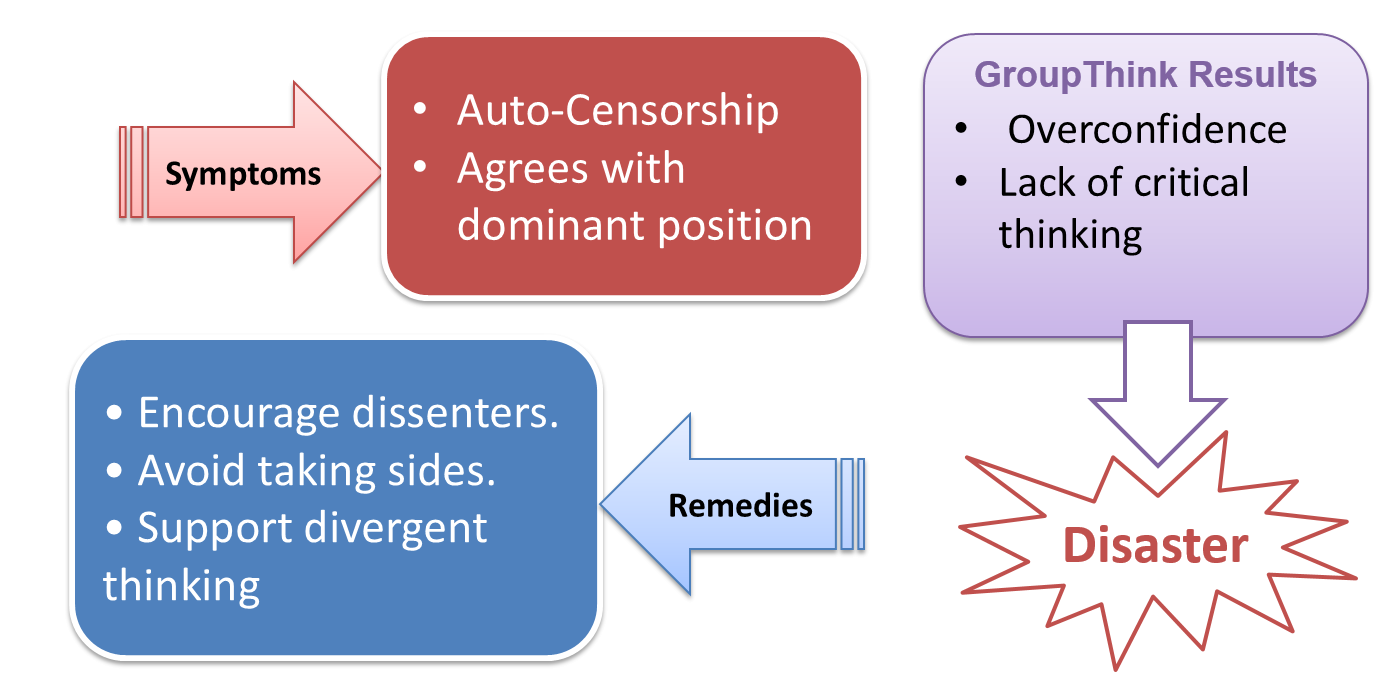
Located somewhere between Peer-Pressure and Dictatorship, GroupThink is defined as "a psychological phenomenon that occurs within a group of people in which the desire for harmony or conformity in the group results in an irrational or dysfunctional decision-making outcome."

Interestingly enough, this opens up the door for unscrupulous manipulators who know their way around this phenomenon to position key players who would subscribe to their agenda and alter the collective consciousness of the others through passive intimidation.

So what happens exactly when, in a business context,  the primary goal of a group member becomes to achieve group satisfaction rather than to find a truly successful decision based on their own expertise and point of view?


Summary Illustration of GroupThink Dynamics

In a real life example from my various consultancy projects, someone in a position of power was systematically trying to introduce into their company, in various open vacancies, an array of people with whom he has personal ties. He had already a core team of "groupies" around him that bullied everyone else into signing up into their way of doing things (regardless of how correct or NOT it was).

The meetings I attended with these individuals were always plagued by the same pattern of behavior. The inner circle persons to this influential individual would always advance an idea or an agenda or a solution and the rest would systematically fall in line. While there might have been some debate and [constructive] discussions at first, as more groupies were added to the team, the dissenting opinions were less outspoken and tended to agree faster with all the nonsense advanced by the others.

Naturally, the quality of work suffered and was obvious in several key opportunities being lost. To an external observer this was an inescapable truth but to the applauding masses, everything was just peachy.

As these dynamics tend to destabilize work and create problems it's a must for oversight bodies and individuals such as the HR department, or a highly placed manager to detect such anomalies and introduce remedies that work aim to mitigate and eventually eliminate this tendency.

Dissenting opinions are not troublesome, they are a healthy to critical thinking, managers should be always willing to listen to these opinions regardless of who is advancing them. Even someone who is being negative because they are unhappy can bring about important wake-up calls to the sleep-walking corporate environment.
An idea would be to assign always in each project a devil's advocate whose job would be to poke holes at the presented idea. Such divergent thinking when incorporated into the companies processes and procedures allows for early trouble-shooting and anticipatory measures rather than after-the-fact fire-fighting.

So, if you occasionally [often] feel you are a nuisance to colleagues who all seems to flow in unique harmony [think The Blue Danube - 1939 MGM Cartoon ] simply because you present a different point of view, keep your chin up,  it's probably not you, it's them!


2017-01-07

How Essential Is Employee Engagement For Your Brand?

On Friday, I was asked to tag along to visit several dealerships in a hunt for a new car. Having grown up around cars in my late father's car repair shop, my entourage believe that I bring added insight to the matter, a misconception I maintain thanks to Google and the internet.

When we set out on our grand tour, my companion told me beforehand which brand dealerships they had visited and which car had ranked more points in in the quest for it to be The One.

As we hopped from one dealership to another, met with their salespeople, discussed the various vehicles specs and budgets and eventually had our own post review discussion, it dawned on me that there was a close correlation between some specific wording used by the salespeople and how we perceived the brand from our angle as customers.
Out of 5 dealerships we visited I noticed the following:

  • 3 dealerships left us unimpressed, one of which was completely unpleasant
  • 2 dealerships were great, one of which was really excellent.


I am not going to mention which is which because this is not the point of this piece and because there are enough people on blogs whoring themselves out to brands. What I will mention though is the common denominator among the 3 dealerships which offered the most disappointing experience. During our visit to each of those, we naturally asked a lot of questions about the exhibited vehicles, their features, the lack of certain options and models and whether they might be bringing those into the local market. In retrospect, I noticed that in each case the salesperson would refer to his own dealership  as "they". To be clear, they did not refer to the brand but to the local dealership (management)
  • They chose not to include these options in the car
  • They chose not to bring this model to Lebanon
  • They decided to raise the price
  • They prefer not to sell this...

This was aggravated by a more detached body language that made us feel that the salespeople just wanted to be done with answering the questions in order to go take a break.
Compared to the two locations where we had a good experience, this inferred a major disconnect between management and its employees. In both locations that made it to the final selection lists, salespeople distinguished themselves by:
  • A more upbeat demeanor: they would immediately notice a new client walking in, greet promptly and engage in helpful but non intrusive discussion.
  • They ALWAYS talked about their offerings and vehicles by using "WE":
    • We have the best rated vehicles
    • We have superior after sales
    • We have the best deal in this range of vehicles
This forced me to do some introspection about my own behavior in various instances of jobs, associations and activities that I had been a part of. I can safely say that the correlation applied also to me.  The best example I can give is my past experience in the Telecom sector:
  • While working with Cellis (FTML) one of the first two mobile operators in Lebanon, my speech always used the "We" form.
  • When Cellis was substituted by what is now Alfa and the plethora of companies that have subsequently managed this brand name ("managed" being an overstatement here), myself and several of my colleagues drifted slowly but surely to using "They" when referring to the company even while we still worked there.
In essence, no matter how deep business owners, management teams or any person in charge of  brands choose to bury their heads in the sands of "employees are here to slave for me", at some point they need to wake up to the smell of disgruntled staff passively sabotaging the business just by their demeanor and body language (to begin with).
The only time a business can carry on not giving a damn about it's employees and not suffer the consequences is when it is monopolizing a sector (and we know all about that in Lebanon).

It goes beyond any doubt that whatever you seed internally in terms of employee engagement will surely trickle down to you customers. It won't matter how many discounts you do, how many offers you release, your brand will be always associated with the resentment emanating from your customer-facing staff.
Good luck getting rid of that stench!

2016-08-01

They watched an Andes Beer ad, you'll never know what they did next...

First of all apologies for the clickbait title...but I found it very ironic and innocuous to use, compared to what  happened to the Andes Beer ads here below.

One upon a time, there was this excellent beer brand out of Argentina called Andes beer.
They were famous for groundbreaking ads like the "TeleTransporter", The Female Name Tornadoes, The Fairest night... but their best ads and my favorites are by far the "Lost" ads or Decubiados.

source: www.andes.com.ar


The ads, designed to promote the new can and stickers on the bottles that change color when the beer is at the optimal temperature for drinking, were done in an amazingly funny and dark humor twist, showing friends or loved ones in very delicate situations acting insensitively towards their friends who are suffering. The voice at the end comes out with a very serious and deep tone to declare:
"If you don't know when is the right time to drink a beer, we are going to tell you"

I'll let you watch it for yourself:


I made it a purpose to show this to each and every person whom I had known to be in the ad industry or an ad lover. I enjoyed the brilliance of these ads and wanted to share it with as many people possible....until the day where I saw these pathetic examples of advertising soiling our screens.

I can only imagine what happened because I have a vivid imagination, but the public will never know the beauty of the original ads, just the silly stereotypical "men are from mars women are from venus" lame attempt at humor without any point behind it.
You can watch them below and admire the voiceover work that attempts to mimic the same tone in the original ads...


It starts off bad


Gets worse afterwards

Turns to boring

Ends up totally lame


So now you know what they did next...


2016-07-01

If Magazine Covers Were Honest


I almost never buy any magazines, aside from the Smash Hits & Photos magazines I bought as a teenager, my only encounters with magazines are at doctors' clinics and when they run TV ads citing their headlines. This has not stopped me from being highly admirative of the amount of bullshit that these magazines can dish out, especially in their titles a.k.a the ancestors of clickbait.

I conceived this cover a couple of days ago as an attempt at satire, based on first-hand experienc with the topics I chose to highlight. Many people picked-up on the gest of it but others were not on the same frequency and asked me to explain. So here goes nothing:

Mashrou' Leila: This highly overrated and barely audible Lebanese band rose to international fame by using the openly gay card of their lead singer, thus creating controversy in a region not receptive to such a public declaration. Their die hard fans usually accuse their critics of being homophobic to suppress the fact that their sound closely resembles that of a squeaking door.

Facebook Posts: In these tumultuous times that we live in, where the world seems to implode on itself, with a war raging next door, refugees flooding the country and other continents, and a general malaise swarming up globally, one cannot escape the numerous "humanitarian" status updates by individuals who claim to support or defend a good cause but who in fact use a passive-aggressive approach to advance their political views at the expense of those who are actually suffering.

Freebies: I don't need to explain this much, as it's become public knowledge the amount of bloggers who just echo promo material offered by brands or agencies. Some of them still hide behind their finger (ironically so), others are just outright shameless about it. Of course it's fine if a blogger monetizes their presence, just make sure you still offer valuable content not just act as a billboard, because we're on to you...yes, you...you know who you are!

Brexit Nightlife: That's basically putting a buzzword which is trending now (Brexit) with another buzzword which seems the only thing going for us in Lebanon since the end of the civil war. Who would not want to know more how a Brexit is going to help the Lebanese nightlife? Woohoo Lebanese F***ing Joie de Vivre baby!

So folks, scurry along now and don't forget to pick up your edition before it runs out...it's selling like hotcakes!


Links to the original posts:


2016-04-29

Social Media Workshop with Rotary Club of Metn Gate, in Support of Sesobel

Sesobel is a Lebanese NGO founded in 1976 acting as a Social Service for the Welfare of Lebanese Children. Their work is highly known and very few are the chances for someone living in Lebanon to have not heard of them yet. Rotary Clubs a,k.a Lions Club are an international organization known for its clubs which usually attract people from different walks of life and expertise who are usually organized as chapters that work towards addressing and improving many social issues while upholding ethical behavior.

When a Lions Club is organizing workshops and courses in order to support an association like Sesobel, no matter how busy you are, you tend to say  "I'll be there". That's what happened when a friend of mine reached out and proposed I become part of this effort, organized by the Rotary Club of Metn Gate.


So on May 2nd, 4th, 9th and 11th, I will be facilitating 4 sessions of 3 hours each discussing various aspects of social media.

Our plan is to cover the following points:


  • May 2nd:
  • Introduction on Social Media
  • Business Value of Social 
  • Choosing Your Medium
  • Building Your Team
  • Dos & Dont's
  • May 4th:
  • Facebook Intro
  • Business vs Personal Pages
  • Advertising on Facebook
  • Hands on exercise: Launching a Page
  • May 9th:
  • Twitter Intro
  • Best Practices & Examples
  • Tools & Useful Sites
  • Hands-on Exercise: Launching a Twitter Account
  • May 11th:
  • Overview on Instagram
  • Overview on Snapchat
  • Overview on Pinterest
  • Social Media Crisis Management
  • Putting it all Together

But those of you who know me or have attended any of my workshops, know it's never a clean cut syllabus but more of an explorative journey where we dive into the subject and navigate it based on the audience's feedback and interaction.

If you are interested in my workshop or any of the other workshops offered by other distinguished professionals, I strongly urge you to subscribe on the following link a.s.a.p. You would be gaining valuable insights and also giving back to those in need of assistance via Sesobel.

For additional information and registration.


2016-04-25

From Crisis Communication to Roman Ruins: Euromed PPRD Workshop in Jordan

My long experience in facilitating courses and workshops has taught me that no two audiences are alike, much less when you are moving into an entirely new country and culture.
The EUROMED PPRD SOUTH II program landed this past week in Jordan. A country rich in history tradition, sunshine but most of all in warmth from its people. As a Lebanese, I can assert that there is a special bond that always connects us Levantines with each other. We have shared history, geography, climate, traditions, family ties not to mention woes and troubles.
Jordan has always been one of the most welcoming places I have visited and I was extremely enthusiastic to be back there again, this time with the PPRD team.
In case you have not caught wind of what our workshops are about, they are part of a bigger effort to prepare mediterranean countries to face crisis and disasters. Our team addresses Communication in times of Crisis more specifically and helps countries create the awareness needed to build their communication teams and apply the right communication strategy for those difficult times.

The audience in Amman was similar in structure to what we had noticed in Beirut, in the sense that attendance extended beyond the Civil Defense forces to include members of various ministries and official bodies. We did however have members of the (official) press present with us like in Algiers.

Excellent Workshop with my Colleagues Laurent Vibert & Veronique Ruggirello


The Jordanian hosts' enthusiasm for the learning process was no less than their counterparts in previous workshops. Although hesitant at first, and not sure what to expect  from this workshop, they quickly got into the motion, with some taking-on leading roles among the group in various exercises, such as the simulated TV interview or the Social Media Crisis simulation.

The Civil Defense members extended their hospitality further by offering us an amazing trip into the ancient but well preserved ruins of Jarash, located roughly 45 minutes north of the capital. This trip was extremely exciting for me personally, as I am a big fan of historical sites. My previous shorter visits to the country had not left me enough time to go admire such beautiful pieces of history.

In our free time, we also managed to uncover beautiful parts of a city that is friendly, safe, vibrant and with a great potential for more achievements.
We left hoping that our visit helped bring valuable insights to the brave men and women of the civil defense and other public protection services with whom we managed to build friendship and camaraderie ties.

As for me, I can only say one thing: See you soon Jordan!!


2016-04-10

Algeria: Leading by Example in Civil Protection

Within the series of seminars and workshops, part of the EUROMED PPRD SOUTH II program. Funded by the European Union, and after a previous stop in Beirut, we headed for the Algerian capital where the Civil Protection Communication Team was eagerly waiting to be part of this global endeavor to empower similar public bodies in Crisis Communication.

On a personal level, this was my first trip to Algiers, a place not to be missed. The city rich in history, architecture and cultural diversity is impressive to say the least. The welcome we received by our hosts was beyond compare, even in my home country Lebanon where we usually take pride in how we receive travelers and guests.
I am here inclined to start thanking people by name but that would simply mean I would be either leaving someone out or just having a blog post consisting mostly of names of fine people who put their lives daily on the line to save others, so I will just throw out a big thank you to everyone involved in making our stay a memorable one.

In terms of work done, the attendees came from various units within the Algerian Civil Protection located in different parts of the country. We were also graced by the presence of local public and private media institutions representatives.
I have always been a fan of having more varied profiles in workshops and courses I have facilitated over the years. This was definitely the case, as different backgrounds joined in to deliver more insights into our discussions, to allow a more comprehensive approach to hands-on exercises and to keep the conversation alive from different perspectives.

Our workshop which focuses on a 360 approach to communication in times of crisis, took off with the usual theoretical approach to the subject on day 1 followed by a custom conceived crisis scenario mimicking a potential incident that could happen in the country.
The hands-on approach lasted for the remaining 3 days tackling respectively communication with the written press, TV and Radio interviews and culminated in the digital and social media communication part where we discussed the various strategies and tactics alongside the tools that can be used.
Each phase of the work saw the attendees investing themselves fully in role playing and tackling the hard interview questions or the snappy tweets and comments in an extremely professional way.
If something stood out most from this workshop, it was the team spirit with which everyone was working. Boundaries between the media and the civil protection members dissolved quickly and they were each bringing their own expertise to the mix.


This has been one of the most fruitful workshops we have facilitated during the whole program. There is no greater reward for a facilitator than to see that the information is flowing in a productive way and seeing that one's recommendations are being followed.

Algeria, it has been both a pleasure and privilege to have met the brave people that go beyond the call of duty in protecting the public. Here's to continued success!


Next on our agenda is Jordan, where we will be conducting a workshop in Amman on the 18th of April.

I leave you with some photos I snapped from our day out in Algiers with the Civil Protection teams


An amazing day out in Algiers with the awesome members of the Algerian Civil Protection members, discovering the city and their impressive headquarters.

2016-02-28

Empowering Crisis Communication through Workshops

For slightly more than a year, I have been actively involved in a series of seminars and workshops as part of the EUROMED PPRD SOUTH II program. Funded by the European Union, the program aims to increase Prevention, Preparedness and Response to natural and manmade Disasters.
One of the cornerstones of this effort resides in managing communication in times of crisis. For this purpose, we have been enabling public sector entities across the southern mediterranean with the know-how to implement an effective communication strategy, with the right mix of written, audio-visual and digital elements.
Workshops that initially received participants from multiple countries, allowed cross cultural barriers to be taken down and gave insights on how each country would communicate during a crisis, giving a much clearer image on what needed to be done on the national level.

Earlier this week, we embarked with the national workshops: a more focused "on steroids" version of the introductory workshops. The target is for national authorities to designate representatives of various entities that would be playing a key role in a smooth communication in times of crisis.

Beirut was the first to benefit from this, and I was thrilled to have kicked off this effort in my home city that, I believe, stands to benefit the most in these difficult times we are facing.
Further workshops are planned in the coming months in both Algeria and Jordan.

The Beirut workshop, held at the Grand Serial under the auspices of Lebanon's Prime Minister's Office, grouped members of rescue services, security forces, public ministries and official press agency.
Spanning over 4 days, we were able to introduce attendees to the general basis of communication, print media, radio, TV interviews, press conference and , most importantly, the proper use of digital tools and social media channels.


Initially met with resistance from some of the attendees, who deemed themselves to be already well versed in these disciplines, we were glad to later discover a cohesive group of individuals who invested themselves in each simulation. Q&As were elaborate and diverse and the audience emphasised at the end of the workshop the skills they acquired, wishing there had been more time to dwell on topics even longer.
There can be no greater satisfaction for a group of facilitators than to see that the message they have tried to deliver was well received. This group of attendees was exceptionally committed to learning and applying what they had learned in terms of crisis communication management.
While I hope they will never be faced with a crisis big enough to require them to all gather again to address it, I am twice thrilled, as a speaker and as a citizen, to see such a commitment from the public sector into issues of national importance.

Experts Team
I share the credit for this success with the fine people from the Prime Minister's Office: Veronique Azar, Nathalie Zaarour and other staff, and my excellent expert colleagues: Veronique Ruggirello (Kalimat Communication) , Laurent Vibert (Nitidis) and Cherine Yazbeck (Reporter at France 24)
Our team of experts is currently working on a Communication Workshop tailored for the private sector. If you are looking to empower your teams with the help of multinational experts, feel free to reach out to me on patrick.chemali@sharplemon.com or to any of my colleagues and we will gladly work with you to address your needs.

2015-12-31

Time After Sometime


On the brink of another year, we are often bombarded with all the wishy-washy resolutions, recommendations and inescapable avalanche of hopefulness. We are often socially cornered into reciprocating greetings that are founded on nothing but the governing rules of planet rotation in a vast universe where what you wish for and what could happen are totally independent.
So why do we indulge in such self-deluding practices in spite of the accumulated payload of broken resolutions, unfulfilled wishes and thankless self-investments in misguided endeavors?

The long answer would involve diving into the history of civilization, the local customs of ethnic groups and the anchored superstitious beliefs handed over from one generation to another.

The short one is that we are afraid.

Time being the only irrecoverable and irreplaceable commodity during our limited existence, we try to bend it and wield its unstoppable progress by putting roadblocks in its way. We plan for that diet to start on Monday, we get that 6 months gym subscription, we prepare that 3  year business plan, we celebrate anniversaries for our relationships and offspring and magically expect that when a number on the calendar changes, it will divert the path of events previously set in motion by all the choices we made before.

Although my rambling here might make me sound like a Bond villain whose world domination goal is wreak havoc in the world by destroying all the clocks and calendars, I am not.
I am quite the opposite actually, a very precise, time-efficient professional (heck, I've even been recently reproached that I am not a team player when it comes to coming in late and dragging my feet all day to be in sync with the others after hours).

The finer point I am trying to make is that, although we need our lives to be regulated by a quantified notion of time, we should not rely on these quantifications to auspiciously or ominously bring about change. So on this last day of the year, I'll gladly take your wishes for a happy 2016 and will reciprocate them with goodwill, but deep down inside (and a bit at the corner of my mouth) I will be saying that it doesn't really matter what you or I wish.  Things will happen and we'll have to deal with them as they do. After all, like Omar Al Khayyam once said:


“The Moving Finger writes; and, having writ,
Moves on: nor all thy Piety nor Wit
Shall lure it back to cancel half a Line,
Nor all thy Tears wash out a Word of it.”

2015-11-21

Noise, A Modern Affliction


Not one day goes by without me reading some article on how some expert has designated something as the disease of the century. Be it a real physical affliction or a quirk in our social norms, there is a label ready for each to make it much more sensational. Therefore, I am jumping on the bandwagon with my own theory and I double dare you to stop me.

From Heart disease to bad posture through smoking all the way to mobile device addiction all these observed issues could be interpreted as a byproduct of noise. But what is noise exactly?

In its most basic and common definition, noise can be explained as any unwanted sound. Mozart (who was a great composer) could be considered noise if you are not into listening to his genius compositions.
This acoustic definition was extended into many disciplines where noise is considered as an unwanted interference any type of signal that a person is trying to pick up on. 

I must confess that the spark behind this idea came when I recently plugged my earphones at a location I was in,  without actually turning on any music or sound. I realized that all I was attempting to do was to dampen the noise that was throwing me off balance.

Perhaps the auditory noise is the one I need to explain the least,  but still,  it is amazing how much of it we accept without questioning. The indistinct sound of a laptop fan, the silent humming of car tires on the asphalt, the distant rumble of a backup power generator, the infinite amount of beeps that electronic devices emit. Each taken separately may not amount to much but when piled up together they can take a toll on one's nerves and focus.

One thing I was struck by when I first visited East Europe over 15 years ago was how uniform (and dull) their soviet era architecture was. It was shocking for me to imagine all these people living in a place that lacks the individualistic character and creativity which perhaps that was a contributing factor in the demise of those regimes. But the opposite case is not any better. In Lebanon we have become accustomed to a complete lack of urban regulation. From the old refined architecture of houses in Ashrafieh to the adjacent skyscrapers (oh those skyscrapers) everything is just flooding you with a million styles in a total lack of harmony. You can delude yourself and call it charming and unique, inject words and expressions like amalgam and melting pot,  but but it's just noise. My colleagues in the ad industry will hate me for this but the amount of billboards and message boards scattered everywhere does not help make things better and is often a major source of visual noise. But it's not just on the scale of the city, it's everywhere: window dressing of shops, graphic designs of brochures, the layout of websites, the menus of restaurants, everybody is shouting louder with visual elements to cover the competition.

Ironically enough, even this blog post is noise. Among the plethora of publications , news sites, technical review sites, bloggers, vloggers, podcasters, instragrammers and duckfacers we are swarmed by a huge amount of information that makes it really hard to establish the single most important thing for a knowledge seeker: Relevancy!
By the time I have identified that a published piece is relevant to what I trying to inform myself on, I have already wasted precious time that I could have used more productively or leisurely. This issue is perhaps the biggest problem facing the internet. A problem that Google aimed at solving through its innovative algorithm since they started their brilliant journey but which still escapes them to greater degrees. Facebook's social graph and attempts at making information sort-able have been equally shy at best.

The omnipresence of handheld devices, multiplied by the advent of wearables, makes it such that we are always responding to a bleep, a buzz or a nudge. Others have also grown to meet such notifications with indignation should you miss out, ignore or delay responding to any of them.
I am not sure if this is a pure Mediterrano-Arab thing, but even our face to face encounters have to be fraught with constant "telling" and nagging and flaunting to a point where sitting quietly enjoying the moment has become a sign of malaise leading up the proverbial "shou bek?" (what's wrong?) 


So, now what? 
Well, if you are basking in the sunshine of you mobile screen,  shaking it to the sound of your mobile notifications on a rooftop, under a well lit billboard of the latest discounted offering of a sportswear brand, listening to a bunch of friends tell you about their exploits, while a 40 something year old adolescent revs his Harley at 2 AM in the street below, then there's nothing to do and you are just fine as you are. Just live it up!

On the other hand, if you feel this is overwhelming then you need to start figuring out what are the essentials that you cannot give up and then gradually tailor your day-to-day life around them, doing away with all that you feel is impeding on your well being. 
Perhaps a week-end out of town is worth much more than those smart gimmicks you've been craving.
Perhaps as a creative you don't need to hammer people with all those messages, colors, tunes, watchamacallits...
Perhaps as an architect you can let your ego take a nap and not try to outdo the building next door by making that purple facade...well..purple..

Cultivating a culture of silence or more accurately a culture of "the absence of noise" is definitely easier said than done. It starts by identifying one's priorities, what we really care about in our essence as opposed to all the gimmicks we have grown accustomed to, and eventually shedding that extra weight we have picked up along the way.
If you can't understand what I have rambled about throughout this article, I invite you to take a trip abroad or just a walk in one of Lebanon's few remaining pristine natural escapes. The symbiotic nature of the great outdoors offer much to learn from and are a screaming contrast (yes, yes I know ) to the noise ridden urban life we have all come to lead.


2015-03-11

And it's back...ArabNet 2015

Yes it's that time of the year where tech enthusiasts, business professionals and various professional and financial bodies get to rub elbows with all the real and wannabe entrepreneurs.
Of course not everybody there really know why they are attending, it remains however essential for any professional in digital and innovation to be present.
The various insights into new industry trends on the local and regional scenes have always proven their value.
It also a very good opportunity to extend one's network reach. Just make sure you are not behaving like a used car salesman handing out business cards. Careful selecting whom to connect to and how you can synergize with them is a cornerstone of building solid business relationships.

As a blogger evolving in this ecosystem, I was invited once more this year. I will be warping my business schedule to make it there. Give me a shout if you want to connect during the event.


PS: Below is the event's official press release:


2015-03-04

Appeer Makes App Discovery Social

Those of us who are regular twitter users might have noticed when, a while ago, twitter started pushing updates that inform us about what some of the people we follow have been up to. I would wake up and find that A, B & C users have favorited a tweet, or retweeted user X, or followed user Y.
Although I initially had mixed feelings about this feature since I didn't really solicit that info, I grew to like it as it often offered valuable insights into interesting updates and users to follow.

Appeer does just that to the process of discovering interesting apps for your (Android) smartphone.
Once installed and activated Appeer will introduce the user to a community of...yes you guessed it...peers, who each would willingly allow the community to discover when they install an App in exchange of knowing what others are installing. After all sharing is caring as they say.

Using the follow and follow back approach, along with a timeline tab and a recommendation tab, one is definitely bound to receive custom tailored recommendation based on community interaction.
The app also allows the user to export their own list of installed apps as well as bookmarking of interesting suggestions for later review.


I joined their beta community and I must admit that in spite of being still in beta and several bugs being reported, the app seemed already mature enough. Of course large scale adoption might bring to light more user requests or bugs surfacing but that's just the nature of the beast. The team behind the app seem dedicated and responsive enough to ensure smooth sailing.

Appeer is the sort of app that you probably never knew you wanted or needed but that would succeed in surprising you once you start using it. The app is due to go live for the public on March 6th 2015
Below is the official release statement:


Appeer Announces The Launch Of Its Recommendation Platform, Aims To Provide Users With Personally Crafted App Recommendations
- Appeer will give users an unprecedented insight into the world of apps based on their own app inventory and the personal network of people they follow.
- Using an algorithm based on app inventory and social connection to build a tailor-made list of app recommendations, Appeer improves on the current app discovery process.
-“This app bypasses so many of the issues that consumers have when trying to discover the next great app. Apps can now discover you.” — Co-Founder and CEO Jason Allen,
- According to Nielsen, users spent an average of 30 hours, 15 minutes on their apps in Q4 2013, a full half-day more than the 18 hours, 18 minutes spent in Q4 2011. However, this rise in use does not mirror the average number of apps used, which only increased from 23.2 in 2011 to 26.8 apps per month in 2013.

March __ 2015, Austin-based Appeer announces the launch of its app recommendation platform, aims to provide a personalized app discovery experience for its users.
Available March 6, 2015 for free via Google Play for Android devices, Appeer will give users an unprecedented insight into the world of apps based on their own app inventory and the personal network of people they follow.
Designed as a sleek app recommendation engine that is both user-friendly and powerful, Appeer app looks beyond paid app ads, review sites, and “popular app” sections of app stores to pair its users with the perfect app or game.
Utilizing an algorithm that automatically follows people on behalf of a user in order to build a tailor-made list of app recommendations, the Appeer improves on the current app discovery process.
“Within 30 seconds of opening the app for the first time Appeer offers dozens of personally tailored recommendations that will update regularly,” says Appeer Co-Founder and CEO Jason Allen. “This app bypasses so many of the issues that consumers have when trying to discover the next great app,” he adds.
The app’s suite of features include push notifications that allow users to install a recommended app directly from Google Play, a viewable timeline of recommendations, and the ability to export the user's app inventory to four different formats.
“Additionally, users will be able to bookmark recommended apps so they can check them out later, even if the recommendation comes to them through a push notification,” says Appeer Technical Co-Founder Komra Beth Salo. “If they really like an app, users can share the recommendation via Appeer to their contacts or friends on social networks,” she adds.
“Our competitors are being paid to recommend apps to their users. Appeer only gives organic recommendations because our focus is on providing the best recommendations for our users,” explains CEO Jason Allen.
As the adoption of smartphones continues to rise on a global scale, so does the overall time we spend using apps or playing games. According to Nielsen, users spent an average of 30 hours, 15 minutes on their apps in Q4 2013, a full half-day more than the 18 hours, 18 minutes spent in Q4 2011. However, these figures are not mirrored by the average number of apps used, which only increased from 23.2 in 2011 to 26.8 apps per month in 2013.
With thousands of new apps being developed everyday — a large number of which are available for free — it is hard to look beyond these numbers without seeing a real need for a powerful and dynamic
app discovery tool like Appeer.
Aiming to change the way we discover new apps, Appeer moves beyond the “Top App” charts highlighted by the App Store and Google Play, and places the focus back on the individual user.
About
Founded in 2014 by Jason Allen, Komra Beth Salo and Milan Cubic, Austin-based Appeer is a new Android app, which aims to change how users discover great new Apps and Games. The Appeer app creates personally tailored app and game recommendations based on a user’s profile. Recommendations can be viewed in the app or received by the user via notifications on their device.

Contact 
Name: Eddie Arrieta


Phone: 1-646-480-0356


Email: eddie@publicize.co